LEGO® SERIOUS PLAY®
“Is That Actually a Thing?”
Developed by the LEGO Group in the 1990s in collaboration with business researchers Johan Roos and Bart Victor, who were exploring new ways to improve strategic thinking, communication, and innovation, the LEGO® SERIOUS PLAY® methodology has since been used around the world by businesses, universities, public sector organisations, healthcare providers, and charities.
It is a powerful, hands-on facilitation methodology that helps people think, communicate and solve problems in ways that traditional discussions often cannot.
Every model tells a story. Rather than discussing issues in the abstract, participants create something tangible and visible that can be explored, shared and understood by others. Using bricks as a thinking and storytelling tool, participants build models that represent their ideas, experiences, challenges and aspirations. The process taps into the connection between the hands and the brain, helping people access thoughts and insights that may be difficult to express in words alone.
By making connections between ideas visible and giving people a safe, creative way to explore them, LEGO® SERIOUS PLAY® can help individuals and teams:
- Gain deeper self-awareness
- Understand and appreciate different perspectives
- Explore the connections between systems and environments they work within
- Strengthen communication and collaboration
- Build healthier, more connected cultures
- Generate innovative solutions and fresh thinking about opportunities
- Turn insight into meaningful action
When people build, they think differently. When they think differently, new possibilities emerge.
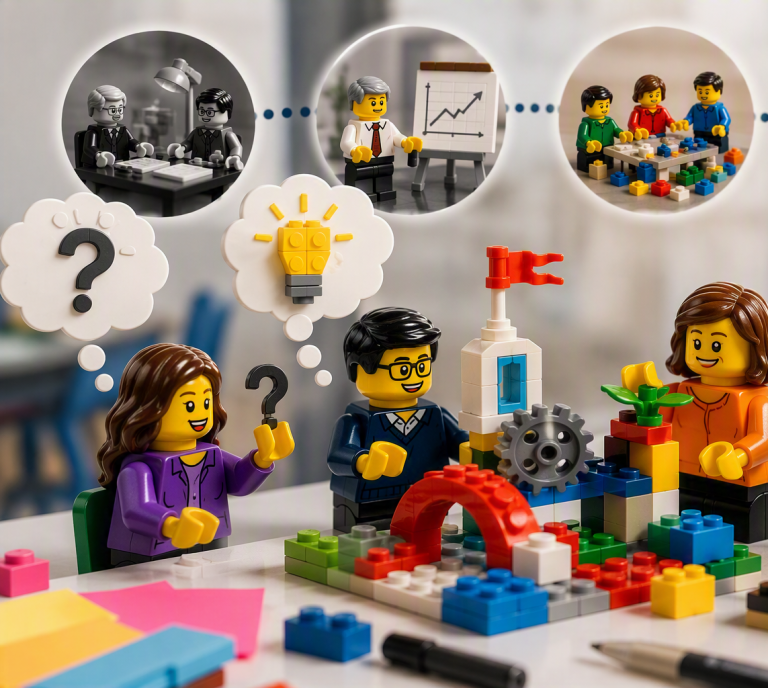
This is, without a doubt, the question we're asked most often. And the answer is a resounding "yes!"
But, it's a fair question. At first glance, using LEGO® bricks in a professional setting can seem unexpected.
We've also heard all the initial reactions:
"Isn't that a bit childish?"
"My colleagues would never go for that."
"How can LEGO® possibly help with strategy, governance or organisational development?"
The concern, however, is usually less about the bricks and more about doing something that feels different. But it's in the difference where the true value lies; If we only ever use familiar approaches, we can only ever expect familiar outcomes.